194R TDS on client gifts: when you must deduct
When 194R TDS applies to a gift to a client or dealer, where the rule now sits under the new Income-tax Act, and how many gifts take one dealer past the yearly limit.
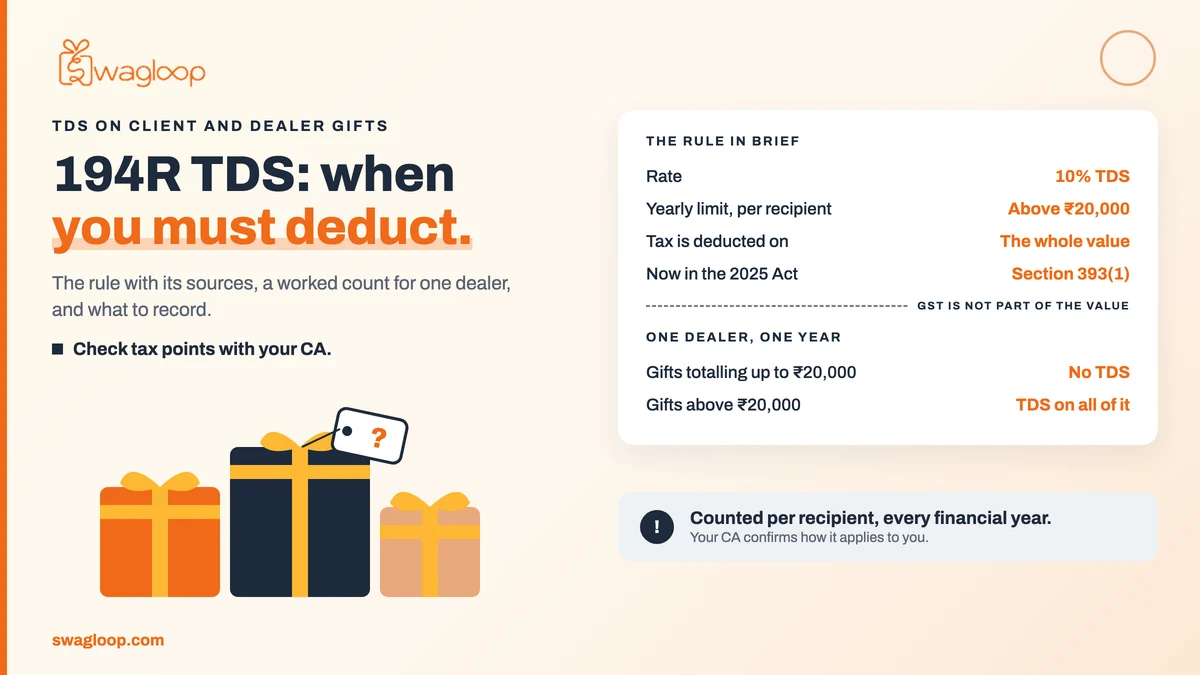
Yes, 194R TDS can apply to a gift to a client or dealer. If everything you give one business or professional recipient adds up to more than ₹20,000 in a financial year, 10% TDS is due on the whole value, not just the part above ₹20,000.
The Income-tax Act, 2025 has replaced the Income-tax Act, 1961, so section 194R is no longer the current law. The same rule now sits in section 393(1), Table S. No. 8(iv), of the Income-tax Act, 2025, at 10% once the yearly total passes ₹20,000 (Income Tax Department TDS FAQ). This guide gives the rule with its sources, counts how many gifts it takes to cross the line for one dealer, and lists what to record. If you're still choosing what to send, start with corporate gifts for clients.
This is general information, not tax advice. Check your own case with your CA.
When does 194R TDS apply to a gift?
It applies when your company provides a gift to a resident, the gift arises from that resident's business or profession, and the yearly total is above ₹20,000. All four of these have to hold:
- You provide a benefit or perquisite. A gift box counts, whether or not it can be turned into money.
- The recipient is a resident in India and receives it through their business or profession. A dealer, a distributor or a client's business fits.
- The value you provide, or are likely to provide, in the financial year is above ₹20,000. Gifts totalling up to ₹20,000 don't cross it.
- You aren't an individual or HUF below the turnover limit under section 194R: ₹1 crore for business or ₹50 lakh for a profession, in the year before.
The Income Tax Department's explainer on TDS on benefits and perquisites sets these out for section 194R (Income Tax Department, 2026). CBDT Circular 18/2022 repeats the rate, the ₹20,000 test and the turnover exemption (CBDT, 2022).
The rate is 10% of the value, and surcharge and cess are not added. Tax is due on the entire value, not merely the excess over ₹20,000. If the recipient hasn't given a PAN, the department's TDS FAQ says tax is deducted at the table rate, the rate in force or 20%, whichever is higher (Income Tax Department, 2026).
Which gifts need TDS, and which don't?
Only gifts that arise from the recipient's business or profession and pass ₹20,000 in a year need TDS. This table covers the common cases.
| Who gets it | TDS under 194R? | Source |
|---|---|---|
| A dealer or distributor, gifts above ₹20,000 in a financial year | Yes, 10% on the entire value | Income Tax Department explainer |
| The same dealer, gifts up to ₹20,000 in the year | No | Department TDS FAQ, section 393(1), Table S. No. 8(iv) |
| A client company, where its owner, director or employee uses the gift | Yes, if the company's total goes above ₹20,000. Tax is deducted in the company's name, and the limit is counted for the company, not per person | Income Tax Department explainer |
| An incentive in kind, such as a phone, a gold coin or a sponsored trip | Yes, and it adds to the same yearly total as your gift boxes | Income Tax Department explainer |
| A sales discount, cash discount or rebate on the sale price | No | Income Tax Department explainer |
| A government entity that carries on no business or profession | No | Income Tax Department explainer |
| A client who is an individual | Depends on whether the gift arises from their business or profession | Ask your CA |
| Your own employees | No. A gift to an employee is a salary perquisite, handled through payroll, not under this rule | Our guide to tax on employee gifts |
What the department's explainer says
The rule makes the giver responsible for the tax, and it falls due before the gift leaves your hands. The department's explainer says the person providing the benefit to a resident "shall ensure that, before providing such benefit or perquisite, tax is deducted from the value of such benefit or perquisite".
A gift box is wholly in kind, so there is no cash to deduct from. In that case the explainer says you must ensure the tax has been paid before you release the gift. The dealer can pay it as advance tax, and you can rely on their declaration and a copy of the advance tax challan.
The value is the fair market value, except in two cases. If you bought the gift before giving it, your purchase price is the value. If you make the item yourself, the value is the price you charge your customers for it. GST is not included in either case.
Skipping it has a cost. On the old section 194R, the explainer says a giver who fails to deduct is treated as an assessee in default, with interest of 1% for every month or part of a month. Ask your CA how that reads under the Income-tax Act, 2025.
Worked example: gifts to one dealer across a year
About 7 gifts of around ₹3,000 each are enough to take one dealer above ₹20,000 in a financial year, and cheaper gifts take more. To find the gift that crosses the line, divide the ₹20,000 TDS limit by the value of one gift and take the next whole number above the answer.
| Value of one gift | Gifts to one dealer to go above ₹20,000 |
|---|---|
| Around ₹3,000 | 7, which come to about ₹21,000 |
| Around ₹2,000 | 11. Ten come to exactly ₹20,000, which is not above the TDS limit |
| Around ₹1,500 | 14, which come to about ₹21,000 |
| Around ₹1,000 | 21. Twenty come to exactly ₹20,000, which is not above the TDS limit |
Our client sets cover this range, from the Recognition Hamper and the Elite 6-in-1 Signature Edition up to the Ring Edge Elite Corporate Essentials, the White Luxe Minimalist Executive Set and the Luxury Wooden 6-in-1 Business Gift Set. For the current price, open the product page or ask us for the catalogue. Count with the price you actually pay, because a gift a little above a row's figure crosses the line with fewer gifts.
Seven gifts at around ₹3,000 come to about ₹21,000, so TDS at 10% is about ₹2,100, and the 10% applies to the whole ₹21,000. The Luxury Wooden set holds a wooden notebook and pen, an insulated flask, a power bank, a wireless mouse and a data cable kit.
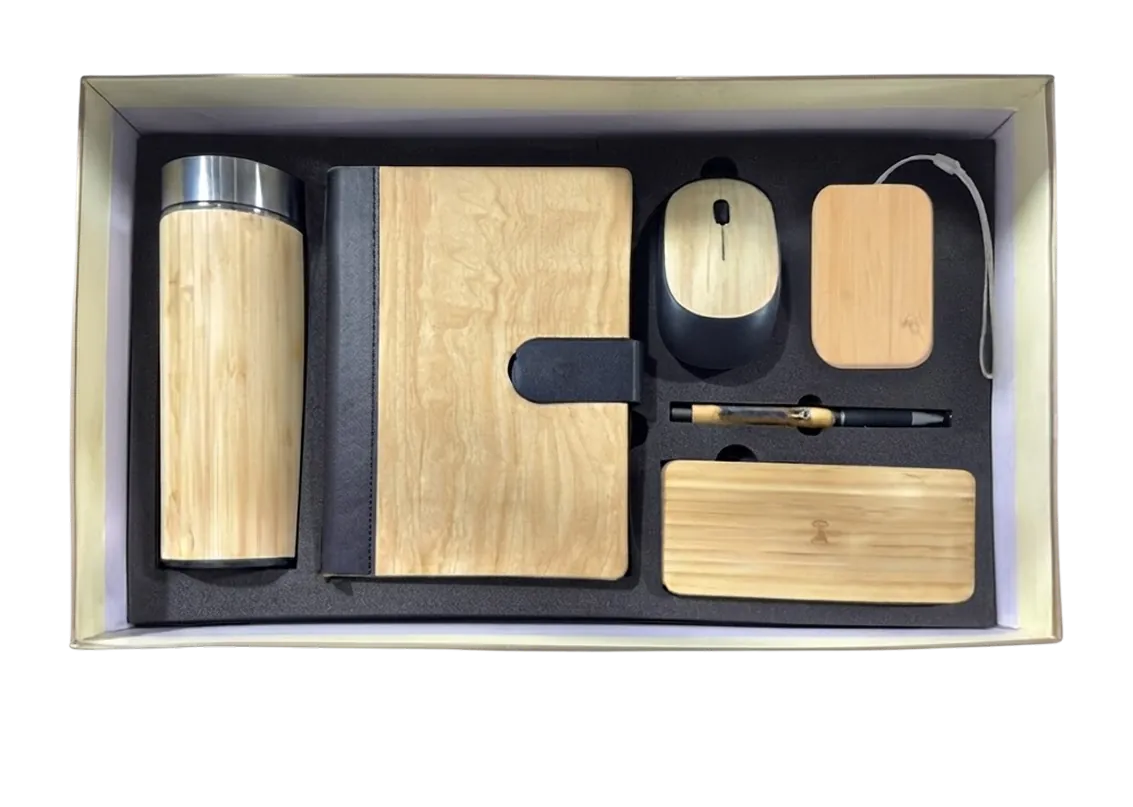
Now the programme view. About 120 dealers, one box each at around ₹2,000 a head, comes to about ₹2.4 lakh. No dealer passes ₹20,000 on that box alone, so that gift on its own raises no TDS.
The catch is the rest of the year. The rule counts the value provided or likely to be provided in the financial year, so a festival box, a year-end box and an incentive trip add up for the same dealer. Two boxes come to about ₹4,000, and an incentive worth around ₹17,000 on top takes that dealer to about ₹21,000. Then 10% TDS applies to the whole ₹21,000, boxes included.
Does reimbursing an expense count?
It depends on whose name is on the invoice. If the expense is invoiced in the name of the person making the reimbursement, it isn't treated as a benefit or perquisite. If the invoice is in someone else's name, it is, even when the reimbursement is cost to cost (Income Tax Department, 2026, in the explainer).
What to record for each gift
Keep one line per gift per recipient, because the test for gifts above ₹20,000 runs on each recipient's yearly total. Your accounts team needs these columns:
- The recipient's name and PAN, and whether the gift arises from their business or profession.
- The date, the occasion and what was sent.
- What you paid for it, with GST left out.
- The running total for that recipient in the financial year.
- How the tax was settled before release: deducted or paid on your side, or paid by the recipient as advance tax with a declaration and a challan copy.
I'd start the list before the first gift of the year, because the rule counts gifts you are likely to give and not only the ones already sent.
Check with your CA
Ask your CA about these points before you rely on any of this for your own company:
- Timing. The explainer is written on section 194R and says tax is deducted, or paid, before the gift is released. Ask how section 393(1) reads for you.
- Value. The explainer speaks of the purchase price. Ask whether branding, packing and freight count.
- Clients who are individuals, and whether their gifts arise from business or profession.
- Your own turnover, and whether the individual or HUF exemption from section 194R applies to you under section 393.
How a Swagloop order fits this
Every Swagloop order comes with a GST invoice, and we ship anywhere in India, to one address or to each recipient. That suits a dealer list, where each person gets their own parcel and their own line in your record.
Companies generally cannot claim input tax credit on goods given away as gifts (CBIC Circular 92/11/2019-GST, 2019). A GST invoice does not mean you can claim it. Ask your CA.
We usually work with 40 units per design. If you need fewer, tell us and we'll work something out. We send a proof or order summary for you to approve before production starts, and confirmation means you've confirmed the order and approved the artwork.
Orders ship within 12 to 14 working days of order confirmation, from our only warehouse, in Dwarka, New Delhi. After dispatch, allow up to 3 working days in Delhi NCR and up to 6 working days elsewhere in India. Our team takes a year-end break, and nothing ships in that window.
Confirm your order and artwork at least 5 weeks before the gifts must arrive, or 6 weeks if those weeks include 24 December to 3 January. For the North East, Jammu and Kashmir, Ladakh and the islands, ask us for a date first. If we get it wrong, such as a defect, a misprint, transit damage or a short shipment, we fix, replace, credit or refund it.
Planning dealer or client gifts for the year? Browse corporate gifts for clients, read our guides to gifting channel partners and client gift ideas, or ask us for a quote with your list of recipients.